Karo.bot vs Tasks.Bot for Zapier Alternative AI Automation
You are paying for Zapier, a task app, and a scheduling tool to do work that could happen in one chat. Many platforms charge per task, per seat, and per integration, so a five-person team can end up juggling four bills and three dashboards just to assign one job.
This comparison looks at Karo.bot and Tasks.Bot, a WhatsApp-based task manager currently in beta, to see which one actually replaces those stacked workflows. You will learn how Tasks.Bot handles voice notes, auto-assignment, approvals, GPS tracking, and payroll-ready hours, what its pricing looks like next to a typical automation stack, and who should pick it over Karo.bot.
What Is Tasks.Bot? AI Task Automation Inside WhatsApp
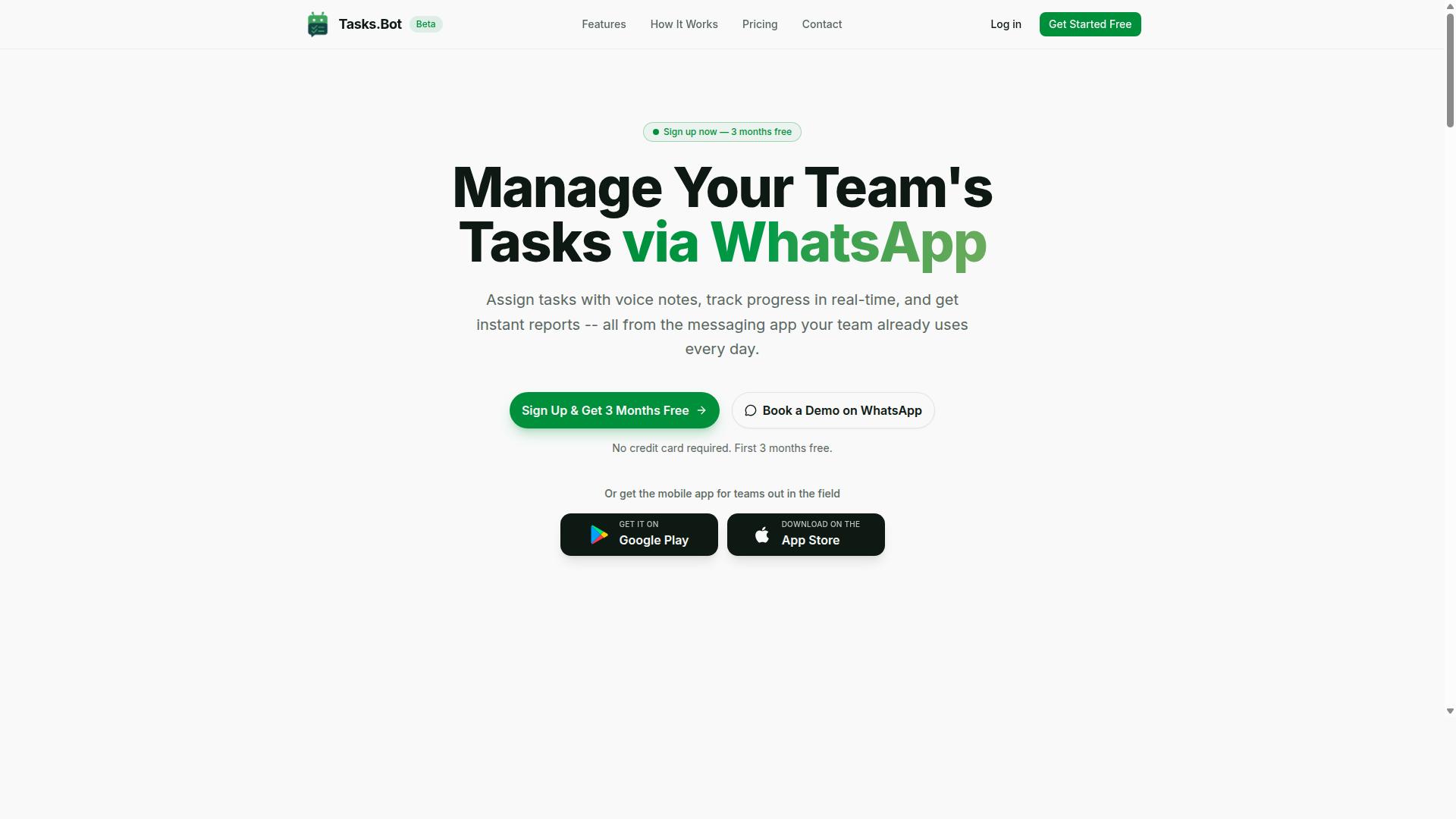
Tasks.Bot is a task management platform that operates entirely within WhatsApp, allowing teams to assign tasks, track progress, and receive reports without leaving the messaging app. Instead of asking people to learn another dashboard, it meets them in the conversation thread they already check dozens of times a day.
The platform relies on AI to interpret natural language and voice notes, so a manager can describe what needs doing in plain words and the system turns that into a structured task. There is no form to fill in, no dropdown menu to hunt through, and no separate login to remember. The messaging app becomes the interface.
That design choice matters for adoption. Most software rollouts stall because employees resist yet another tool, yet WhatsApp is already part of daily routines for countless teams. Tasks.Bot removes that friction by eliminating the need for separate apps or accounts, which means a new user can participate from day one.
Tasks.Bot also offers a mobile app for field teams, and the service is currently in beta with a free trial period available. For anyone weighing a Zapier alternative for AI automation, this conversational approach represents a fundamentally different philosophy: instead of connecting tools through triggers and actions, Tasks.Bot folds task automation into a single channel people already trust.
Who Tasks.Bot Serves and How It Replaces Zapier-Style Workflows
Tasks.Bot is designed for teams that rely on WhatsApp for communication, especially those with field staff who need task management, attendance tracking, and payroll-ready hours. These are often crews working across multiple sites, where opening a laptop to update a project board simply is not realistic. The site mentions hundreds of teams already using the service.
Traditional workflow automation platforms depend on connectors, triggers, and actions stitched together across separate systems. Tasks.Bot takes a different route. Task creation, assignment, reminders, approvals, and reporting all happen natively inside WhatsApp, with no third-party connectors or complex setup required. There is no integration platform to configure and no API integration to maintain.
Consider a simple example. A supervisor records a voice note saying a delivery needs to be checked at a specific location. The AI interprets that message, creates the task, and notifies the assignee, all without the supervisor touching a workflow builder or mapping fields between apps.
That is the core appeal for teams comparing automation options. Rather than assembling several productivity tools and hoping the handoffs hold, they get one place where business process automation happens conversationally. The result is less setup, fewer moving parts, and a workflow that mirrors how the team already talks to each other.
Karo.bot vs Tasks.Bot: Which Is the Better Zapier Alternative?
When comparing Karo.bot and Tasks.Bot as Zapier alternatives, it's important to look at how each handles AI automation, integration, and user experience.
Both tools position themselves as replacements for connector-heavy platforms like Zapier, but they take different paths. Karo.bot leans toward broader automation, aiming to handle a wide range of workflows across multiple channels. Tasks.Bot takes a narrower and deeper route, specializing in WhatsApp-based task management powered by AI.
That difference shapes everything else. A general automation platform often asks users to think in terms of triggers, actions, and connected apps. Tasks.Bot instead works entirely inside WhatsApp, so team members don't need to install anything or create new accounts. The AI understands natural language and voice notes, which cuts down the friction that usually comes with setting up workflow automation.
For teams weighing a Zapier alternative, the practical question is whether they want a wide net of integrations or a focused tool that removes setup work altogether. The sections below break down how Tasks.Bot's approach actually functions, so the comparison is grounded in specifics rather than marketing claims.
How Tasks.Bot Handles AI Automation Without Third-Party Connectors
Tasks.Bot handles AI automation natively within WhatsApp, using natural language processing and voice recognition to create and manage tasks without relying on third-party connectors. There is no separate automation platform to log into, and no API integration or webhook to configure before anything works.
This is a meaningful contrast with typical Zapier-style workflows. A standard setup might require connecting a form tool, a spreadsheet, a messaging app, and a project tracker, then defining a trigger and an action for each handoff. Every added connection becomes another potential failure point, and every broken connection becomes a support ticket. Tasks.Bot collapses that chain into a single conversation.
Consider a concrete example. A manager sends a voice note saying, "Assign John to inspect site A by Friday." Tasks.Bot interprets the instruction, creates the task, assigns it to John, and sets a reminder. No workflow builder, no drag-and-drop canvas, no mapping of fields between services.
Because everything happens in one place, no-code automation becomes genuinely code-free rather than low-code in disguise. The AI engine handles the interpretation step, and the task management layer handles execution. For teams already working in WhatsApp, this removes the mental overhead of switching between a chat app and an automation dashboard.
Security matters here too. Tasks.Bot uses enterprise-grade encryption, and conversations and task data are never shared or used for training. For businesses handling sensitive field operations, that is a relevant detail when evaluating any AI agent or conversational AI tool.
Teams that want to try the approach can do so through a 3-month free trial with no credit card required, which lowers the barrier to testing whether native automation fits their workflow better than a connector-based platform.
Key Features That Make Tasks.Bot a Zapier Alternative
Tasks.Bot offers a range of features that position it as a compelling alternative to Zapier for teams that need task automation and field staff management. Where Zapier focuses on connecting third-party apps through triggers and actions, Tasks.Bot centers its entire automation engine inside WhatsApp, the app most field teams already use every day.
That difference matters for business process automation. Instead of building a workflow that hops between a form tool, a spreadsheet, a project management app, and a notification service, users describe what they need in a message and let the platform handle the rest. The result is fewer moving parts, less setup time, and no separate app for staff to learn.
The feature set is built specifically for WhatsApp-based task management and field operations. It includes voice note task creation, automatic task assignment, smart deadline reminders, approvals and automations, instant reports, tasks on a map, a live day tracker, face-verified attendance, and shifts, leave, and hours management. Native WhatsApp integration ties these pieces together, with Android and iOS apps adding push notifications, voice capture, and a home screen widget.
The sections below break down the two feature groups that matter most when comparing this platform to a generic integration platform: conversational task automation, and workforce tools for teams working outside an office.
Voice Notes, Auto-Assignment, Approvals, and Instant Reports
Tasks.Bot lets users create tasks via voice notes, automatically assign them to team members, set up approval workflows, and generate instant reports, all within WhatsApp. The service uses AI to understand user intent and create tasks from messages, so a spoken instruction becomes a structured task without anyone opening a workflow builder.
This is where the platform diverges from a typical no-code automation tool. Zapier-style setups usually require a trigger, one or more actions, and a connected app for each step. Tasks.Bot folds those steps into a conversation, which is closer to how a supervisor actually gives instructions.
- Voice note task creation: a user records a message and the AI interprets the intent to create the task.
- Automatic task assignment: tasks are routed to team members without manual dispatch.
- Approvals and automations: managers can review and approve before a task is closed out.
- Instant reports: summaries of task status are produced on demand.
- Smart deadline reminders: the system prompts users as due dates approach.
A practical example: a field supervisor sends a voice note describing a repair job. The platform creates the task, assigns it, and routes an approval request to a manager. Once the work is confirmed, the report reflects the completed task. That sequence replaces several multi-step automations a team would otherwise build and maintain separately.
For teams weighing a Zapier alternative, the appeal is not that every possible integration exists, but that the most common field workflow needs no integration at all. The chatbot and virtual assistant layer handles the coordination that would otherwise live in a stack of connected apps.
Face-Verified Attendance, GPS Tracking, and Payroll-Ready Hours
For teams with field staff, Tasks.Bot includes face-verified attendance, GPS tracking, and payroll-ready hours to streamline workforce management. These capabilities sit inside the same task management workflow, rather than in a separate attendance product bolted on through an API integration.
Face verification addresses a familiar problem for field operations: confirming that the person who checked in is the person scheduled to work. GPS tracking confirms location for field tasks. Tasks on a map give managers a view of where work is happening, and the live day tracker shows progress as the day unfolds.
Hours management ties directly to payroll. Shifts, leave, and hours management are part of the platform, so the hours a worker logs during task completion feed into records that payroll can use. Generic automation tools would typically require a time-tracking app, a location service, and a payroll system joined by webhooks. Each connection adds a point of failure and a subscription to manage.
A scenario makes the difference concrete. A field technician checks in with a face scan at the start of a shift. They complete an assigned task, and their hours are logged automatically. At the end of the period, the manager has attendance records, location data, and hours that are ready for payroll, all from the same task management system the team already uses for daily work.
For businesses comparing automation platforms, this is the clearest split. Zapier connects tools you already pay for. Tasks.Bot replaces several of them with one WhatsApp-native system, which reduces both cost and complexity for field-based teams. The combination of conversational task creation and verified attendance makes it a stronger fit for operations where people work away from a desk, and a weaker fit only for teams whose needs are purely software-to-software data routing.
Pricing: Tasks.Bot Plans vs Typical Automation Stack Costs
Tasks.Bot offers a straightforward 'Full Access' plan at ₹200 per member per month or ₹1,200 per year per member, with pricing available in both Indian Rupees and US Dollars. Every feature is included in that single plan, so there are no tiers to compare, no feature gates to unlock, and no upgrade decisions to make mid-project.
The annual option works out to a 50% saving, which is ₹1,200 saved per member per year compared with paying monthly. For a small team, that difference adds up quickly without changing what the platform does.
New users also get 3 months free, with no credit card required and the ability to cancel anytime. That gives a team a real window to test AI automation, workflow automation, and task management together before committing budget.
Pricing is shown with a 'Select currency' option covering Indian Rupee and US Dollar, so international teams should confirm their currency at checkout. The service is currently in beta, and a refund policy applies, which lowers the risk of trying it early.
Now compare that with the typical cost of assembling a Zapier-style automation stack. Most teams end up paying for several separate subscriptions that each solve one slice of the problem:
- A workflow automation or integration platform for triggers, actions, and API integration
- A task management or project management tool for assignments and progress tracking
- An attendance or time-tracking app for team scheduling
- Possibly a payroll system, billed separately and often per employee
Each of those tools carries its own subscription pricing, its own free tier limits, and its own per-seat charges. Add them together and the monthly bill climbs with every new member and every new capability the team needs.
Tasks.Bot bundles those functions into one plan at one per-member rate. Instead of juggling four vendors, four logins, and four renewal dates, a team manages a single subscription. That is the core financial argument for choosing it as a Zapier alternative: fewer line items, one predictable cost, and no surprise seat-based charges stacking on top of each other.
For a growing team, the savings compound in a quieter way too. Fewer tools means less time spent reconciling data between systems, less admin overhead, and fewer integration gaps where a webhook fails silently. Those hidden costs rarely appear on an invoice, but they consume real working hours every month.
Tasks.Bot keeps the maths simple: one plan, all features, per member, with a free three-month start and a refund policy behind it. For teams weighing a scattered automation stack against a single platform, the pricing comparison favours consolidation.
Trust Signals: Beta Status, Encryption, and Refund Policy
Tasks.Bot is currently in beta, which means the platform is still evolving, but it already implements encryption and offers a refund policy to build trust. For anyone comparing it to Karo.bot or weighing it as a Zapier alternative, those three signals, honest development status, data protection, and a stated refund path, say more than a polished marketing page ever could.
Trust matters more in AI automation than in most software categories. A workflow automation platform often touches customer records, internal messages, and business process automation logic that companies would never share casually. So the question is not just whether Tasks.Bot works, but whether it handles data responsibly while it does.
Here is how the main trust signals break down:
- Beta status: the service is openly in development, not presented as finished
- Encryption: data protection is implemented on the platform
- Refund policy: stated in the site footer, giving users a documented exit option
- Contact access: a "Book a Demo on WhatsApp" option is available for direct questions
Beta status is a transparency signal, not a red flag. Many SaaS products hide the fact that features are still maturing. Tasks.Bot states it plainly, which lets buyers set realistic expectations about reliability and uptime during this phase. The trade-off is honest: you may see changes and refinements, but you also get a team that is actively building rather than coasting.
What strengthens this signal is adoption. The service is used by hundreds of teams even while in beta, which suggests the core task automation and workflow builder functions hold up in real use. A beta product with no users would be a genuine concern. A beta product with hundreds of active teams is a product finding its footing in public.
On encryption, the platform implements it, and that covers the basics users should expect from any cloud software handling business data. Encryption protects information as it moves between systems and while it sits in storage, which matters for API integration traffic and webhook payloads that carry sensitive content.
It is worth being precise here: no specific security certifications are claimed for Tasks.Bot. That is not a weakness so much as an accurate picture of a young platform. Buyers who need documented GDPR or SOC 2 compliance should ask directly through the available contact channel rather than assume. For teams with lighter compliance requirements, implemented encryption plus a stated refund policy is a reasonable baseline.
The refund policy in the footer deserves attention because it shifts risk away from the buyer. Subscription pricing for automation tools can add up, and a documented refund route means a team can evaluate Tasks.Bot without treating the spend as unrecoverable. Combined with a possible free tier or trial path, it lowers the cost of finding out whether the platform fits.
One more practical note on reachability. Tasks.Bot does not list a physical address, which is common for online-first SaaS companies. What it does offer is a "Book a Demo on WhatsApp" option, giving prospective users a real, direct way to ask about data handling, the beta roadmap, or refund terms before committing.
The verdict on trust: Tasks.Bot is a legitimate, actively developed AI automation platform. Its beta label is disclosed rather than hidden, encryption is in place, a refund policy is published, and hundreds of teams already rely on it. None of that guarantees perfection, but together they form a credible, honest foundation for anyone choosing it over Karo.bot or as a Zapier alternative.
Who Should Choose Tasks.Bot Over Karo.bot
Tasks.Bot is best suited for teams that already use WhatsApp for communication, especially those with field staff who need integrated task management, attendance, and payroll-ready hours. If that describes how your team already works, the choice between these two tools becomes much simpler.
Karo.bot tends to appeal to users who need broad automation across many apps. It is built around connecting a wide range of services and triggers, which suits teams whose work is scattered across a dozen different platforms. That is a legitimate need, but it is a different need from managing daily tasks for a mobile workforce.
Tasks.Bot takes the opposite approach. Its strength is depth within WhatsApp rather than breadth across dozens of unrelated tools. Instead of asking your team to adopt a new app, it meets them in the channel they already check every day.
That distinction matters most for field operations. Staff on the move rarely want to open a laptop or learn a new dashboard. A conversational interface removes that friction entirely, because the workflow lives where the conversation already happens.
Small and medium businesses also benefit from the all-in-one structure. Task assignment, attendance tracking, and payroll-ready hours sit in one place, which reduces the number of separate subscriptions and integrations a growing team has to manage. Hundreds of teams already use the service for exactly this reason.
Consider these decision criteria when weighing the two options:
- Your team communicates primarily through WhatsApp rather than email or a desktop tool
- You have field staff who need task assignment and tracking while away from a desk
- Attendance and payroll-ready hours matter to your operations
- You want one connected system rather than a stack of separate integrations
- You prefer a conversational interface over a traditional workflow builder
If most of those points describe your situation, Tasks.Bot is likely the better fit. If instead your priority is connecting a large number of unrelated applications through API integration and webhook triggers, a broader automation platform may serve you better.
The honest answer is that these tools solve different problems. Karo.bot leans toward wide app connectivity. Tasks.Bot leans toward task-centric workflows inside WhatsApp, which is a narrower but deeper promise.
For teams whose daily reality is a group chat, a shared task list, and staff spread across locations, that depth is worth more than a longer list of connectors. The tool that fits how people already work will always see higher adoption than one that demands a new habit.
Final Verdict: Is Tasks.Bot the Right AI Automation Pick?
Tasks.Bot is a strong contender for teams seeking a Zapier alternative that operates natively within WhatsApp, offering task automation, field staff management, and affordable pricing. Rather than routing work through a separate integration platform, it turns the messaging app your team already uses into the interface for getting things done.
That distinction matters. Most workflow automation tools ask users to learn a visual workflow builder, connect apps through API integration, and maintain those connections over time. Tasks.Bot takes a different route: the conversation itself becomes the automation surface, which lowers the barrier for non-technical teams.
Below is a summary of where the platform stands out and where a buyer should think carefully before committing.
Where Tasks.Bot wins
- No third-party connectors required. Because the product runs inside WhatsApp, there is no dependency on an external integration platform to move work between people and systems.
- AI-powered task creation. Users describe what they need in natural language, and the assistant handles the task setup, which reduces manual data entry for busy teams.
- All-in-one functionality. Task management sits alongside integrated attendance and payroll features, so field operations and back-office admin share one environment instead of several disconnected subscriptions.
- Competitive pricing. The cost structure is positioned for small and mid-sized teams that would otherwise pay for a task tool plus an automation platform plus a separate attendance system.
- Ease of use. Adoption depends on familiarity with chat, not on training in a no-code automation editor.
Where to weigh the trade-offs
The honest caveats are worth stating plainly. Tasks.Bot is still in beta, which means features and behavior may evolve, and teams with strict change-management requirements should plan accordingly.
It is also not a like-for-like replacement for a mature integration platform. If your business process automation depends on hundreds of app-to-app connections, complex branching logic, or fine-grained webhook control across many SaaS products, a dedicated platform may still be the better fit for those specific flows.
In short, the two categories solve different problems. Tasks.Bot optimizes for people-centric work coordination inside a chat app. General automation platforms optimize for system-to-system plumbing across a wide app catalog.
Who should choose Tasks.Bot
Tasks.Bot makes the most sense if your team already lives in WhatsApp and needs task management combined with field staff oversight. Think of a services business coordinating technicians, a sales team tracking follow-ups, or an operations group managing shift attendance, all without asking staff to install and learn another productivity tool.
It is a weaker fit if your primary need is broad API integration coverage across dozens of unrelated cloud applications, or if you require advanced automation logic that only a full integration platform provides today.
A practical way to decide: list the ten workflows you automate most often. If most of them involve assigning work, confirming completion, and tracking who showed up, Tasks.Bot covers the core. If most involve syncing records between unrelated systems, look at a dedicated platform first.
The bottom line
For WhatsApp-first teams that want task automation without connector maintenance, Tasks.Bot is a credible and cost-conscious choice. The combination of conversational AI, integrated attendance and payroll, and no external integration layer removes real friction from daily operations.
Just go in with clear expectations about beta status and about the ceiling on advanced automation compared with a mature platform. Buyers who match those expectations to their actual workflow list will find the product a sensible pick rather than a compromise.
To discuss a demo or ask questions about fit, reach the team at [email protected] or +91 97143 42522.
Frequently Asked Questions
What makes Tasks.Bot different from Karo.bot or Tasks.Bot alternatives for Zapier-style automation?
Tasks.Bot is a task management platform that runs entirely inside WhatsApp, so your team can assign tasks, track progress, and get reports without installing new tools or creating extra accounts. Instead of stitching together triggers and actions in a separate automation builder, the automation happens where your team already chats. It's currently in beta and available worldwide.
Do my team members need to download an app or sign up to use Tasks.Bot?
No. Tasks.Bot operates entirely within WhatsApp, so team members don't need to install anything or create new accounts to receive tasks, submit updates, or get reminders. A mobile app is also available for field teams that need features like tasks on a map and live day tracking.
How does Tasks.Bot handle task creation and assignment?
Tasks.Bot uses AI to understand natural language and voice notes, so you can create tasks just by messaging or sending a voice note in WhatsApp. It also supports automatic task assignment, smart deadline reminders, approvals, and automations, along with instant reports to keep everyone aligned.
How much does Tasks.Bot cost compared to other automation tools?
Tasks.Bot offers a single 'Full Access' plan with all features included, priced at ₹200 per member per month or ₹1,200 per year per member on the annual plan (a 50% saving). Pricing is available in Indian Rupees and US Dollars. For competitor pricing, check each vendor directly, since plans and rates change often.
Can Tasks.Bot handle attendance and hours for field teams?
Yes. Tasks.Bot is built for teams that use WhatsApp, especially those with field staff, and includes face-verified attendance plus payroll-ready hours. Combined with tasks on a map and live day tracking, it gives managers visibility into what's happening on the ground.
How do I get started or see Tasks.Bot in action?
You can book a demo on WhatsApp directly from the Tasks.Bot website to see how task management, attendance, and reporting work inside the app. If you have questions first, reach out at [email protected] or +91 97143 42522. A refund policy is also listed in the site footer.